

For Dutch version: see www.cochin-approach.nl/blogs buttom “stroomversnelling”
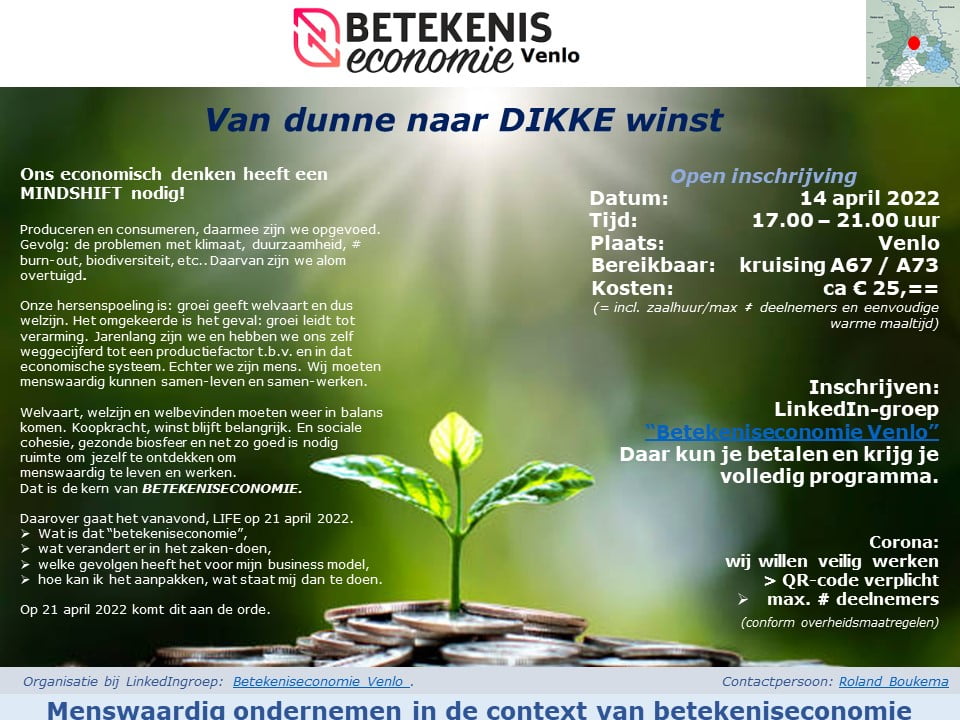
According to meaning economy expert Kees Klomp, we have long since embarked on an irreversible path towards a system in which not the market and profit maximization, but communities and the Earth are central. An economy in which value wins over money.
Our current life and work stems from a decades-long focus on economic growth. After the Second World War, reconstruction was the magic word. Neoliberalism was on the rise and the government withdrew more and more. Soon, serving the economy and increasing gross national product became the supreme and most sanctifying goal of governments. In fact, our executives have become toothless against corporate power, with all the social and environmental consequences that entails.
More prosperity, less well-being
We have been raised and brainwashed with the idea that we are here on Earth to produce and consume. And that as long as we continue in that cart track that the prosperity of a few leads to the well-being of many. However, what we have to conclude is that the opposite is the case: more wealth leads to less well-being. Things like climate change, biodiversity loss and the increasing number of burnouts are all inextricably linked to economic growth. Growth has now become an impoverishment.”
Human = human, no production factor
We are increasingly realizing that for well-being you need much more than just prosperity. We realize that for decades we have simplified ourselves to our economic existence. However, we are much more than a factor of production in that economic system. We are citizen, parent, child, neighbor, friend, partner and a living being. We are part of life and we are connected to all the flora and fauna around us. That part of us we have not watered for a long time and has withered.
Real wealth
Prosperity, well-being and well-being must be brought back into balance. That is the basis for a dignified existence and work. We need a certain amount of wealth to guarantee our well-being and well-being. According to Kees Klomp, research shows that after an income of USD 75,000 per year, there is no longer any relationship between money and happiness. To create a healthy society, all three Ws must be given an equal place. Because people need not only purchasing power, but above all social cohesion, a healthy biosphere and the space to discover themselves in order to flourish.
Own direction
More and more people are choosing to set up their own mini-companies in which business, social and personal are equal and in balance. Such alternatives in the existing economic system can be seen, for example, in energy or food cooperatives. These people take back control of their own lives and make themselves independent from the government and the large business community.
Power of citizens’ initiatives
Many of these initiatives are still local and small-scale. However, they do work. For example, a food cooperative ensures that people no longer buy food in the supermarket at the lowest possible price. The compulsion among farmers to use unethical and planet-unfriendly production methods will disappear as a result. Moreover, such a cooperative produces local and organic food that is healthier, does not cost more. It provides the farmer with a fair wage and does not harm the Earth.
The collective first
These kinds of citizens’ initiatives should become mainstream. As a result, the direction comes to me, the person, the citizen and no longer at the market. The future is that economics will be about the collective interest rather than the individual. The turning point is then that we move away from the question “what does the customer want and what can a producer deliver”. We go to: “what does the community need. And what can we ask of the Earth?” That will be the systematic way of thinking economically, taking into account social and ecological boundaries.
Tilt
It still seems far away, only we have long since tilted. Just look at this. We humans once thought it was very normal for companies to do the most terrible things for their own benefit. That group of people is now definitely in the minority. Companies such as De Vegetarische Slager and Vandebron have also become so interesting that corporates are taking them over because they have added value both ideologically and financially. The more successful meaningful companies, the growth of impact investors, the fact that countries are switching to Gross National Happiness and the gigantic number of cooperatives that are sprouting from the ground: step by step we are moving towards a world in which not profit, but value is central.”
Compassion as the new foundation
Maslow’s pyramid gets a new foundation, namely the existential layer that deals with compassion. If we continue as we do now, our current lifestyle will end in the ruin of humanity. That’s what science has been telling us for decades (certainly from the Club of Rome report). We then have to deal with irreversible processes that have the result that we destroy ourselves. The lesson is that our behavior is always about everything and everyone. All living things on our planet are inextricably linked. We need to see and acknowledge this. This ensures that things like compassion, altruism and empathy do not become lofty spiritual matters, but existential necessities of life. These are the basic conditions for creating a living environment in which we can survive. When all borders, religions and cultures transcend, there is only one truth. We all live on one planet. We need each other to thrive, both now and in the future.
Editing of an interview with Kees Klomp
This is a google translation of www.cochin-approach.nl/blogs buttom “Stroomversnelling”

